Conservation planning usually starts from records of where a species has been seen. A new paper in Biological Conservation by Markus Franzén and Victor Johansson argues that where individuals actually concentrate may matter more for whether a population persists than where the species is merely detected.
Applying inequality measures to butterfly data
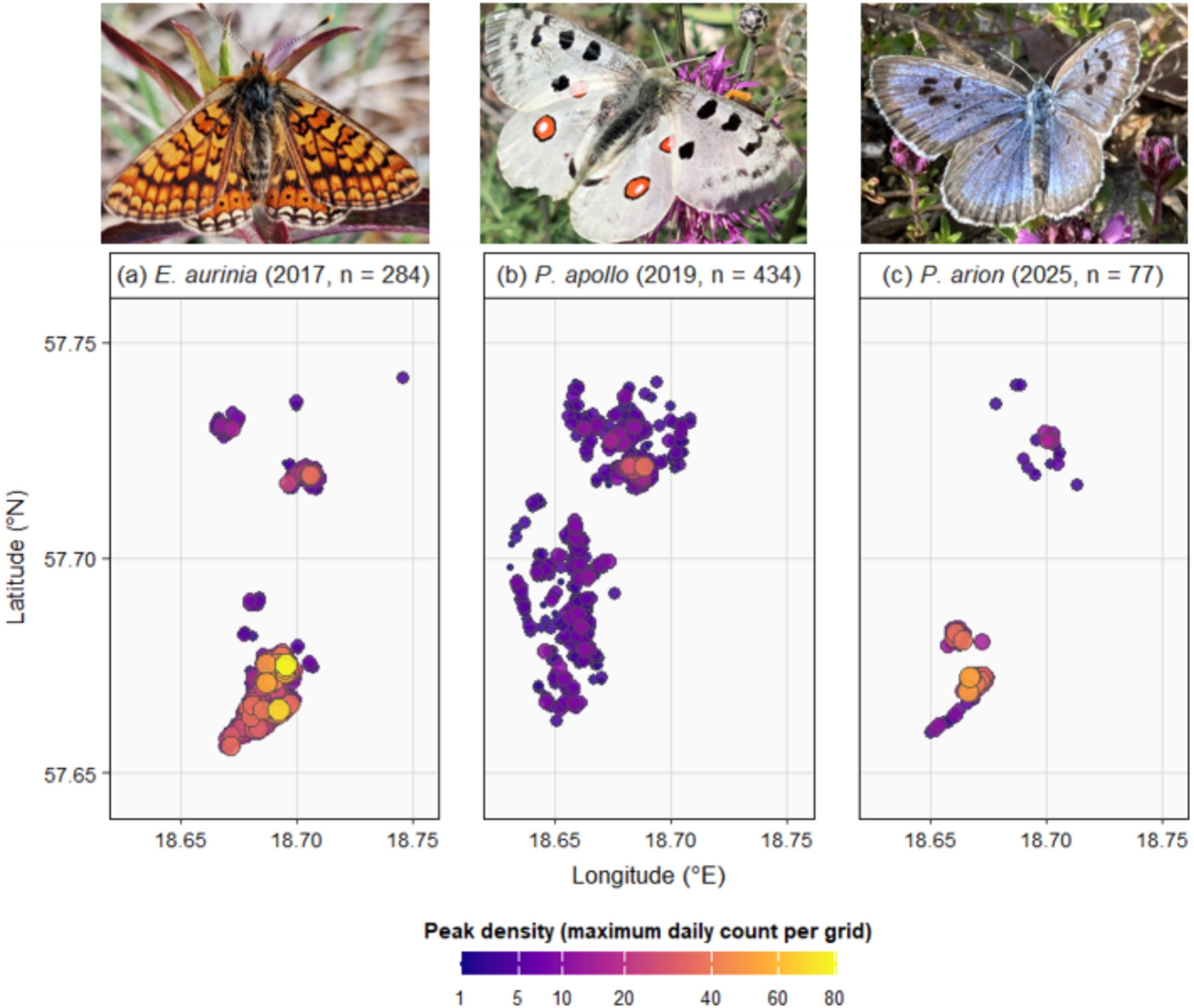
The study applies Lorenz curves and Gini coefficients, measures originally built to quantify inequality in wealth, to abundance data for three grassland butterflies protected under the EU Habitats Directive: the marsh fritillary (Euphydryas aurinia), the Apollo (Parnassius apollo) and the large blue (Phengaris arion). The data cover a 60 km² landscape on Gotland, divided into one-hectare grid cells, giving 795 species-by-grid observations.
Concentrated hotspots drive population numbers
For all three species, peak densities were strongly skewed and spatially concentrated. The top 19 percent of occupied grid cells accounted for between 44 and 53 percent of the summed peak counts, and reaching half of the summed peak counts took only 20 to 25 percent of the occupied cells. Phengaris arion was the most concentrated of the three, Parnassius apollo the least. The ranking held across the different concentration measures tested. What predicts those high-density cells differs by species. Ground moisture and the proportion of grassland were both positively associated with peak density for E. aurinia, and grassland proportion for P. apollo. For P. arion the relationship ran the other way, peak densities fell as grassland proportion rose, and the landscape-scale habitat measures examined predicted it poorly.
Implications for conservation
The practical point is that these high-density sites are hard to pick out from occurrence records alone, yet they are plausible targets for conservation aimed at keeping populations, not just presences. The Lorenz-Gini approach is transferable to other taxa and complements area-based targets by asking explicitly where populations actually persist.